Creative Ways to Use Songs and Music in the Language Classroom
For many language teachers, using songs in the classroom follows a familiar pattern: play the song, hand out a gap-fill worksheet, check the answers, and move on. While this approach has its place, it only scratches the surface of what music can offer language learners.
Songs are far more than entertaining lesson fillers. When used purposefully, they can develop grammar, vocabulary, pronunciation, listening skills, cultural awareness and learner confidence, while making lessons more memorable and engaging. Teachers can move beyond traditional song activities and use music as a powerful teaching tool for learners of all ages.

Why Songs Work
There is a reason people can remember song lyrics they haven’t heard in years. Music creates strong memory associations by combining language with rhythm, melody and emotion.
Songs also expose learners to authentic English. Unlike textbook dialogues, songs often include natural pronunciation, connected speech, contractions and everyday vocabulary. They give students an opportunity to hear how English sounds outside the classroom while also introducing cultural references and themes.
Perhaps most importantly, songs reduce anxiety. Many students feel less self-conscious singing together than speaking individually, creating a more relaxed atmosphere where language acquisition can flourish.
But we’ll soon also find out that using songs in the classroom is more than just singing along!
Think Beyond Listening
At the most basic level, students simply listen, sing and repeat lyrics, building familiarity with sounds and rhythm. The next stage encourages learners to manipulate the text through activities such as lyric ordering or gap-fills.
The real learning begins when teachers move beyond the lyrics themselves. Songs become springboards for discussing themes such as identity, relationships, society or culture, while also providing authentic contexts for teaching grammar, vocabulary and pronunciation.
Rather than treating the song as the lesson, teachers can use it as the starting point for much richer language learning.
Here are some examples:
- Identity – Beautiful – Christina Aguilera
- Relationships – If I were a boy – Beyonce
- Childhood – Stressed out – 21 Pilots
Different Ages, Different Approaches
One of the strengths of music is its flexibility. The same teaching principle can be adapted for learners of almost any age.
Young Learners
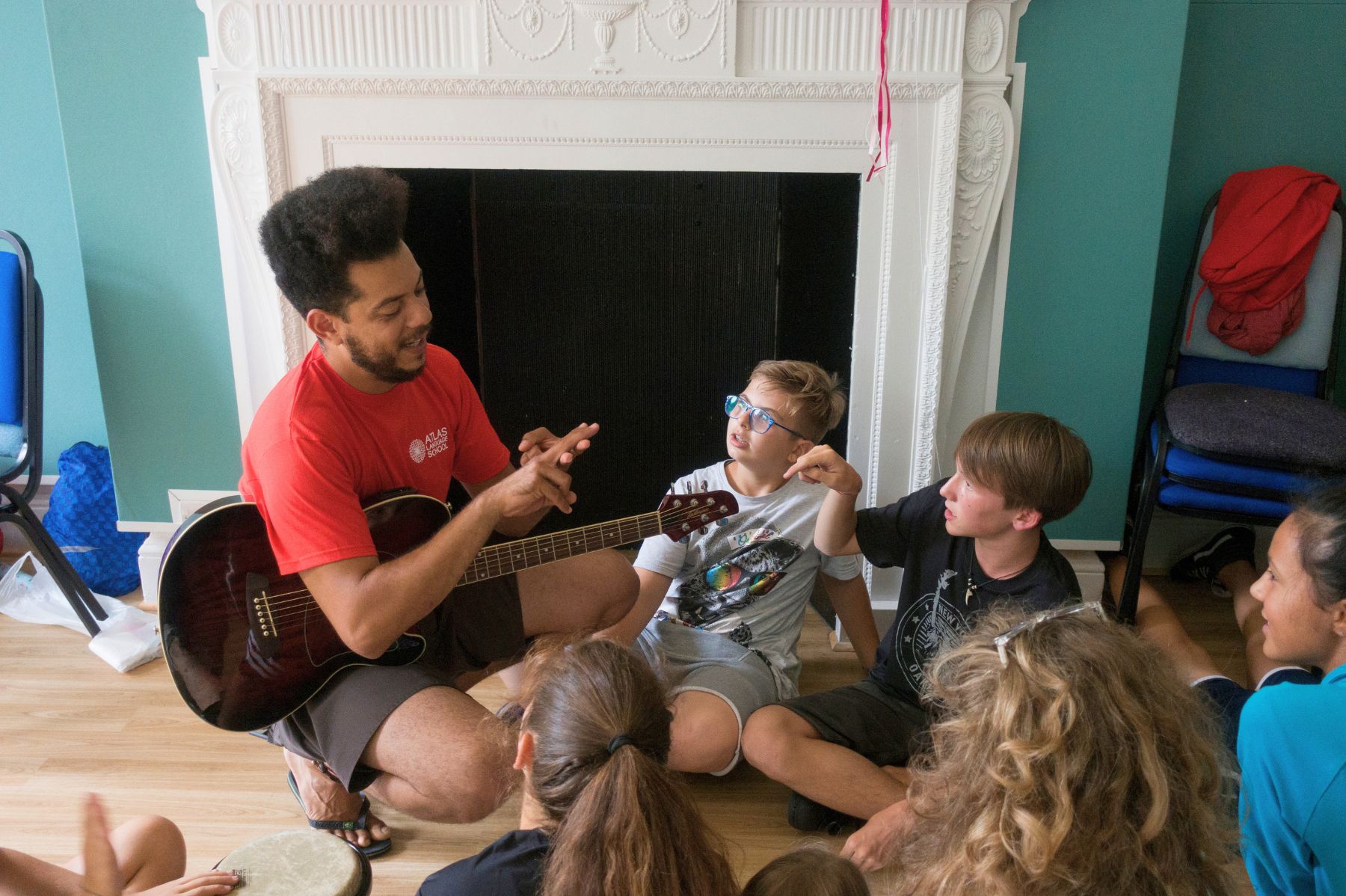
For younger children, action songs remain incredibly effective. Classics such as Heads, Shoulders, Knees and Toes, If You’re Happy and You Know It or The Wheels on the Bus combine movement with language, supporting kinaesthetic learners while reinforcing vocabulary.
Teachers can increase engagement by changing the speed, volume or style of singing, or allowing children to invent new verses and actions. This gives learners ownership of the activity while naturally reinforcing pronunciation, rhythm and intonation.
Teens and Adults
As students become older, activities can become more analytical and creative.
Instead of immediately listening to a song, ask students to predict the order of mixed-up lyrics before checking their ideas. This develops listening skills while encouraging learners to notice narrative structure and discourse markers.
Gap-fill activities can also be improved. Rather than simply writing the missing word, students first predict what could fit, identify the grammatical category required, and justify their choices before listening. This transforms passive listening into active language processing.
Teachers can even ask groups to create their own gap-fill worksheets for classmates, encouraging deeper engagement with vocabulary and grammar.
Songs as Discussion Starters
Some of the most valuable learning happens after the music stops.
Many songs explore universal themes that naturally lend themselves to classroom discussion:
- Identity
- Friendship
- Relationships
- Social issues
- Dreams and ambitions
- Mental health
- Family
- Growing up
For example, after listening to a song about friendship or resilience, students could discuss whether they agree with the singer’s message, compare it to their own experiences, or debate how the story could have ended differently.
This moves lessons from language practice towards genuine communication, which is a key aim of communicative language teaching.
Teaching Grammar Through Music
Grammar often feels more meaningful when learners discover it within authentic texts rather than isolated exercises.
Many popular songs naturally contain useful grammar structures:
- Conditionals
- Narrative tenses
- Modal verbs
- Present perfect
- Passive voice
- Phrasal verbs
Instead of beginning with grammar explanations, teachers can start with the song’s message, check overall understanding, and only then draw students’ attention to the target structure. Meaning comes before form, making grammar more memorable and contextualised.
Another interesting technique introduced in the webinar is grammar anchoring. Students associate specific grammar points with memorable song lyrics. Later, when recalling the grammar, they mentally retrieve the song as a memory cue. For example, I was made for loving you (Kiss) includes the passive voice, as well as ‘for + ING’ to express purpose.
For many learners, this proves much more effective than memorising abstract rules.
Developing Pronunciation Naturally
Songs are excellent models of connected speech.
Students hear features that textbooks often struggle to demonstrate clearly:
- contractions
- weak forms
- linking sounds
- connected speech
- rhythm and stress
Teachers can ask learners to hunt for examples of these pronunciation features within lyrics before listening to confirm their answers. This raises awareness of how spoken English differs from written English and helps learners sound more natural when speaking. Here are some example songs:
- Careless Whisper (George Michael): ‘should’ve known better’ – contractions
- Imagine (John Lennon): ‘Imagine all the people’ – linking
- Passenger (Iggy Pop): ‘I am the Passenger’ – intrusive /j/
- Who do you think you are? (Spice Girls) – intrusive /w/
- Champagne Supernova (Oasis): ‘Champagne Supernova in the Sky’ – intrusive /r/
Vocabulary That Sticks
Vocabulary learning also becomes more meaningful through music.
Rather than pre-teaching long word lists, encourage students to identify interesting or unfamiliar words themselves. They can infer meanings from context, create example sentences or explain the vocabulary to classmates.
This learner-centred approach encourages autonomy and deeper processing.
Teachers can also gamify vocabulary work by assigning different verses to different groups, turning word recognition into a collaborative challenge.
Don’t Forget Music Without Lyrics
Instrumental music has its own place in language classrooms.
Gentle background music can:
- reduce anxiety
- improve concentration
- signal transitions between activities
- create a calm atmosphere during writing or reading tasks
Many teachers already use visual routines to structure lessons; carefully selected music can become an equally effective auditory routine. Allowing students to contribute to a classroom playlist can also increase ownership and engagement, provided the selections remain appropriate for the learning environment.
Choosing the Right Song
Not every popular song belongs in the classroom.
When selecting material, teachers should consider:
- learners’ age and language level
- clarity of pronunciation
- speed of delivery
- cultural appropriateness
- suitability of vocabulary and themes
- absence of offensive language
Perhaps the most important factor is whether the song has something worth talking about. A meaningful topic often generates richer discussion than simply choosing the latest chart hit.
Final Thoughts
Music has always been part of human communication. It tells stories and expresses emotions, making it a valuable resource for language learning.
By moving beyond traditional gap-fill exercises and using songs to develop communication, pronunciation, grammar and critical thinking, teachers can create lessons that students remember long after they leave the classroom.
Ultimately, the most successful song-based lessons don’t just teach language. They encourage curiosity, creativity and genuine interaction. When students leave the class still humming the song and using the language they encountered in it, teachers know that learning has continued beyond the final bell.
Share This Story, Choose Your Platform!
Check out our other recent blog posts!
Creative Ways to Use Songs in the Language Classroom
Creative Ways to Use Songs and Music in the [...]
Atlas Language School in Malta | School Location
Where Is Our Atlas Language School in Malta Located? [...]
Teaching Students Conversations Skills
Teaching Students Conversations Skills As language teachers, we often [...]

Carrot and Stick Motivation in Education
Carrots and Sticks - Motivating Students and Staff in [...]

Medieval Dublin Walking Tour: Vikings, Normans & Hidden History
Medieval Dublin Walking Tour Dublin is a modern city, [...]
Christmas Markets Dublin, Malta & Liverpool | Atlas Guide
Discover Christmas Markets in Dublin, Malta & Liverpool Christmas [...]